
Frequently Asked Questions
We get a lot of questions at JJ Babbitt. That comes with more than a century of shaping the sound of saxophone through some of the most iconic mouthpieces ever made. And now, with our landmark partnership with Theo Wanne Mouthpieces, you may have even more.
Over the years, players have asked about our mouthpieces, our materials, our processes, and even the inconsistencies and misunderstandings that can arise when legacy designs are produced across changing eras and methods. Those questions are fair. And we believe they deserve clear, honest answers.
Today, JJ Babbitt is entering a new chapter. With refined processes, modern manufacturing technology, and a renewed focus on precision, consistency, and repeatability, we are addressing long-standing challenges head-on while protecting the designs and sound that made Otto Link, Meyer, and Hite legendary.
Below you’ll find answers to the most common questions we receive, updated to reflect who we are now, how we build mouthpieces today, and where we’re headed. If you don’t see what you’re looking for, reach out. We’re always happy to talk shop.
Legacy, Change, and What It Means for Players
-
This partnership with Theo Wanne seems to be a major moment for JJ Babbitt and the industry. Why is it such a big deal?
Because this kind of collaboration has never existed in the saxophone mouthpiece world before.
Meyer and Otto Link represent the most influential mouthpiece designs in the history of the instrument. Theo Wanne Mouthpieces represents the highest modern standard for innovation, precision, process control, and modern manufacturing discipline in mouthpiece making today. Each has shaped the industry in different eras, in different ways.
What makes this moment significant is not branding or visibility. It’s convergence.
This partnership brings together the original designs that defined the sound of saxophone with the modern manufacturing capability required to deliver those designs consistently at scale. That combination hasn’t existed until now. It resolves a tension the industry has lived with for decades: iconic designs on one side, modern precision on the other.
When those two finally come together, the result isn’t incremental improvement. It’s a reset of what’s possible.
For players, it means the mouthpieces they’ve longed for in concept can now be trusted in reality. For the industry, it marks a shift away from imitation and workaround solutions. For JJ Babbitt, it’s the beginning of a new era that honors the past by finally doing it justice.
Moments like this don’t happen often. But when they do, the effects are felt for a long time.
-
Are Meyer and Otto Link just becoming Theo Wanne mouthpieces now?
No. Meyer and Otto Link are not becoming Theo Wanne designs.
This partnership is not about replacing the identity of Meyer or Otto Link, and it is not about reshaping them into something they’ve never been. The goal is exactly the opposite: to allow Meyer and Otto Link to become the best, most reliable versions of themselves again.
Theo Wanne Mouthpieces brings world-class process control, precision, and consistency to the partnership, but the designs, tonal intent, and musical identity remain unmistakably Meyer and Otto Link. These mouthpieces are still rooted in the same core geometry, materials, and sound concepts that defined them for generations. What’s changing is not what they are, but how faithfully they are executed.
This partnership exists to ensure that players who have long trusted Meyer and Otto Link can do so again with confidence, without having to look elsewhere or compromise what they love about these mouthpieces.
Meyer and Otto Link aren’t being reinvented. They’re being restored, refined, and delivered with the consistency players have been asking for.
-
Will Meyer and Otto Link mouthpieces cost more because of the new partnership and manufacturing changes?
No. There are no planned price increases for Meyer or Otto Link mouthpieces as a result of this partnership.
From the beginning, our goal was not to reposition Meyer and Otto Link as premium-priced, boutique products. These mouthpieces became iconic because they were accessible, dependable tools for working musicians, students, and professionals alike. That philosophy continues to guide our decisions.
While the partnership with Theo Wanne Mouthpieces brings significant improvements in consistency, precision, and process control, those investments were made to restore trust and reliability, not to immediately pass costs on to players. We believe musicians should benefit from these improvements without being priced out of the sounds they’ve relied on for generations.
Like any manufacturer, pricing may evolve over time as materials, production realities, and market conditions change. But as of now, Meyer and Otto Link remain committed to delivering exceptional value, with a level of quality and consistency that players can finally count on again.
-
Are these still “real” Otto Link and Meyer mouthpieces?
Yes. Absolutely.
Otto Link and Meyer are defined by their designs, materials, and sound, not by nostalgia for a frozen moment in time. The mouthpieces being made today retain the original design intent, tonal core, and character that made these names iconic in the first place.
What has changed is not who these mouthpieces are. It’s how consistently they are made.
In this new era, JJ Babbitt and Theo Wanne are protecting the legacy of Otto Link and Meyer by pairing their historic designs and proprietary material processes with modern manufacturing precision and tighter process control. The goal is not to reinterpret these mouthpieces or modernize them beyond recognition. The goal is to deliver the sound players expect and have longed for, more reliably, piece after piece.
If it says Otto Link or Meyer on the shank, it is meant to sound and feel like the best Otto Link or Meyer you’ve ever played or heard of. That commitment hasn’t changed. The discipline behind delivering it has.
-
Many mouthpiece makers have copied or been inspired by Meyer and Otto Link designs. Why should players look back now?
Because for the first time in a long time, players don’t have to look elsewhere to get the sound they were actually chasing.
For decades, Meyer and Otto Link defined what jazz saxophone sounded like. Those designs became so foundational that much of the modern mouthpiece landscape exists in response to them. Some makers were inspired by that legacy. Others pursued direct copies. Many built reputations by promising a version of the Meyer or Otto Link sound that players felt they could no longer reliably find at the source.
We understand why that happened.
What’s different now is that the original designs are no longer competing against their own inconsistency.
Through this new era at JJ Babbitt and Theo Wanne Mouthpieces, those iconic Meyer and Otto Link designs are being executed with the level of precision, consistency, and repeatability they always deserved. The sound players have been seeking elsewhere is once again coming from the source itself, backed by modern process discipline and manufacturing control.
Copies exist because originals matter. But when the original is finally delivered with confidence and reliability, imitation loses its appeal.
Players don’t have to chase echoes anymore. They can come home.
-
Is Theo Wanne Mouthpieces actually making these mouthpieces now?
Yes, in part, and that’s by design.
These mouthpieces are now made through a split-manufacturing process that combines the strengths of both workshops into one unified standard. Certain stages of manufacturing happen at JJ Babbitt, certain stages happen at Theo Wanne Mouthpieces, and then the mouthpieces return to JJ Babbitt for final finishing, evaluation, and readiness to ship.
So this is not a simple “they make them now” or “we make them now” situation. It’s a shared process with a single goal: protect and advance the iconic Meyer and Otto Link character while elevating precision, consistency, and repeatability to modern expectations.
The mouthpieces are still Meyer and Otto Link in design and voice, now built with a far more controlled and consistent process than in past eras.
In short: JJ Babbitt and Theo Wanne Mouthpieces are building these together, step by step, to one standard.
-
JJ Babbitt used to be legendary. Why did inconsistency become such a problem in the past?
It’s a fair question, and it deserves a direct answer.
Over time, the gap between iconic designs and the discipline required to reproduce them consistently grew wider than it should have. Some excellent mouthpieces still came out during those years, but variability became too common, and players felt it. That undermined trust.
Legacy designs demand exceptional process control. Without it, even great designs can produce unpredictable results.
What’s different now is that JJ Babbitt and Theo Wanne have fundamentally changed how these mouthpieces are built. With modern technology, tighter tolerances, improved measurement standards, and a partnership designed specifically to address consistency, the structural causes of that inconsistency are being completely removed.
This isn’t just about trying harder. It’s about building smarter.
-
I’ve noticed a new look and feel to JJ Babbitt. Is it just marketing fluff?
If it were only visual, it would be fair to be skeptical.
Yes, you’re seeing clearer storytelling, updated visuals, and a more confident voice. But those changes are downstream of something more important: the way the mouthpieces themselves are now being made and the impact its having on their tone and playability.
The renewed confidence comes from real changes in manufacturing discipline, precision, and consistency. When the product improves in a meaningful way, it becomes possible to speak more clearly and transparently about it.
Marketing doesn’t create trust. Performance does.
In this new chapter, we’re not asking players to believe the marketing. We’re inviting them to judge the mouthpieces.
-
Was JJ Babbitt a “closed shop” that didn’t listen to players? Has that changed?
There were seasons when JJ Babbitt was more inward-focused than it should have been. That distance created frustration and the perception that feedback wasn’t always heard. We understand why that reputation formed.
Today, openness and dialogue are essential to how we operate.
Consistency, precision, and meaningful innovation depend on listening closely to players, educators, artists, and retailers. Feedback is not a courtesy. It’s a requirement. The standards we’re holding ourselves to in this new era depend on real-world input and honest evaluation.
If you care enough to ask questions or share feedback, we care enough to listen.
Consistency, Precision, and Process
-
What changed in the manufacturing process, and why now?
The short answer: the standards caught up to the legacy.
For decades, Otto Link and Meyer designs asked more of the manufacturing process than the process could reliably deliver. As player expectations increased and tolerances tightened across the industry, it became clear that protecting these iconic designs required a fundamentally higher level of precision and control.
That’s why JJ Babbitt and Theo Wanne have restructured how these mouthpieces are made.
Through split-manufacturing partnership, we’ve introduced modern CNC machining, tighter tooling tolerances, improved measurement discipline, and deeper process oversight into the core of production. These changes allow us to execute classic designs more accurately and consistently than was possible in prior eras.
The timing isn’t accidental. The goal is not to modernize for novelty’s sake, but to ensure these mouthpieces can meet the expectations of today’s players while remaining true to what made them iconic, allowing seasoned and newer players to experience the tone and playability that made these names the go-to choice for legends and icons of music.
-
How does the new process improve consistency compared to the past?
Consistency improves when variability is removed at the right stages.
In the past, too much variation was introduced throughout process, which meant quality control had to catch problems rather than prevent them…if they could; something unavoidable and fundamental to handcrafting from beginning to end. Today, with Theo Wanne Mouthpieces, improved tooling, CNC machining, and tighter process control establish a far more consistent foundation before final finishing ever begins.
That foundation matters. When geometry, dimensions, and reference points are more accurate upstream, skilled craftspeople can focus on refinement instead of constant correction. The result is mouthpieces that are more predictable, more reliable, and far closer to the intended design from piece to piece.
This doesn’t eliminate individuality or player preference. It eliminates unnecessary surprises.
-
Why did the “Otto Link Lottery” exist, and is it still a thing?
Historically, the “Otto Link Lottery” reputation wasn’t imagined.
When iconic designs are produced without sufficient process control, variability can creep in. Some mouthpieces were exceptional. Others missed the mark. That inconsistency turned what should have been a trusted standard into a gamble for too many players.
The goal of the current manufacturing overhaul is to eliminate that dynamic.
By using CNC machining to establish core geometry and tighter tolerances, then pairing that precision with informed hand-finishing, the variability that fueled the lottery reputation is being systematically removed.
Personal preference will always exist. But needing to sort through multiple mouthpieces just to find one that’s fundamentally right should not. That’s the standard we’re building toward now.
-
How accurate are tip openings and other critical dimensions today?
Accuracy today is the result of both better measurement and better prevention.
Critical dimensions like tip opening, facing length, and table geometry are now produced and verified using defined reference points, calibrated tools, and multi-stage checks. Improved upstream precision means these dimensions are far more repeatable before final inspection even begins.
It’s also worth noting that personal measurements can vary. Differences in gauge design, measurement point, and technique can easily produce different readings on the same mouthpiece.
The most common causes of mismatch are:
-Measuring at different points along the tip rail curve
-Using gauges without a fixed reference “backstop”
-Variations in angle, pressure, or positioning
None of that is meant as a deflection. The standard should be dependable. The expectation should be clear. That’s exactly what the current process is designed to deliver.
Accuracy and repeatability are no longer aspirations. They’re standards.
-
Have there been changes to table flatness on Meyer and Otto Link mouthpieces?
Yes. Table flatness is one of the areas where we’ve made a deliberate, informed change.
Historically, Meyer and Otto Link mouthpieces were finished with a slight table concavity. This was intentional, dating back to the methods of the Meyer Brothers and Otto Link themselves, based on the belief that a subtle “belly” could improve reed seal and contribute to response. Many players learned to adapt to this approach, and in some cases even preferred it.
Over time, however, player expectations and setup realities have become clearer. For many musicians, table concavity introduced an unnecessary variable, affecting reed fit consistency, setup time, and predictability from mouthpiece to mouthpiece.
The modern expectation is straightforward: players want a table that is flat, stable, and reliable. We agree.
Flat tables improve reed fit consistency, reduce setup variables, and make play-testing and response more predictable. That’s why Otto Link and Meyer mouthpieces are now produced with perfectly flat tables as a standard.
This change doesn’t reject the past. It reflects a deeper understanding of how players actually experience their equipment today. The DNA of the design remains intact. The foundation it rests on is simply stronger.
Materials and Craft
-
Do molded and vulcanized hard rubber mouthpieces like Meyer and Otto Link sound different from those made from extruded rubber rod or 3D printed materials?
Yes. And for Meyer and Otto Link, that difference is intentional and foundational.
Meyer and Otto Link hard rubber mouthpieces have always been defined not just by their dimensions, but by how the material itself is created and processed. Through extensive R&D and testing, including work done in partnership with Theo Wanne Mouthpieces, we’ve confirmed that our proprietary molding and vulcanization process is a meaningful contributor to the core sound and response these mouthpieces are known for.
That’s why Meyer and Otto Link hard rubber mouthpieces do not begin as pre-vulcanized bar stock or generic extruded rod. The rubber itself is processed, molded, and vulcanized specifically for these designs before any precision machining takes place. This establishes the density, resonance, and feel that define the “Meyer” and “Link” sound.
Modern CNC machining is then deployed in Theo Wanne’s cutting edge workshop to bring greater accuracy and repeatability to the geometry, and the mouthpieces then return to JJ Babbitt for final finishing. The result is not a compromise between old and new, but a new, unique and unified process that preserves the tonal core while delivering modern consistency.
Other manufacturers may replicate dimensions. What they cannot replicate is the combination of proprietary material processing, iconic design intent, modern precision, and informed finishing that creates the full playing experience.
-
Is today’s hard rubber as good as what was used in the 1930s, 40s, and 50s?
In the ways that matter most to players, yes.
Hard rubber has always been rooted in natural rubber, and that remains true today. Over the decades, certain regulatory and industrial constraints have changed how materials are processed across the industry, but those changes do not eliminate the ability to produce high-quality hard rubber mouthpieces.
What has remained consistent at JJ Babbitt is the core of what defines Meyer and Otto Link hard rubber: proprietary rubber processing, molding, and post-mold vulcanization. That methodology plays a meaningful role in density, resonance, and response, and it continues to be central to how these mouthpieces are made today.
In this new era, that legacy material process is being paired with tighter control and improved repeatability through our partnership with Theo Wanne Mouthpieces. The result is not a departure from the past, but a more disciplined execution of what made those classic mouthpieces special in the first place.
So if the real question is whether modern Meyer and Otto Link hard rubber can still deliver the kind of sound and feel players associate with great vintage pieces, the answer is yes. The standard hasn’t changed. The consistency in meeting it has improved.
-
What role does vulcanization play in the sound and feel of a hard rubber mouthpiece?
Vulcanization is a critical step in turning rubber into a musical material.
In simple terms, vulcanization transforms a soft, unstable rubber compound into a dense, durable material with the structural integrity required for a mouthpiece to perform consistently. But beyond durability, vulcanization plays a meaningful role in how a mouthpiece feels and responds under air.
For Meyer and Otto Link, vulcanization is not a generic, off-the-shelf step. It’s part of a proprietary process that affects density, resonance, and how vibration is transmitted from the reed into the air column. Those characteristics contribute directly to the warmth, core, and familiar response players associate with these mouthpieces across both vintage and modern eras.
In this new era, JJ Babbitt is maintaining that foundational material process while pairing it with tighter control, modern precision, and improved repeatability through our partnership with Theo Wanne Mouthpieces. The goal is not to change what vulcanization gives these mouthpieces, but to ensure those qualities show up more consistently from piece to piece.
Vulcanization isn’t just about making rubber harder. It’s about creating a stable, resonant foundation that allows a mouthpiece to sound and feel like a Meyer or an Otto Link.
-
Why do some older hard rubber mouthpieces turn brown over time?
Hard rubber naturally changes over time.
Exposure to factors like sunlight, heat, humidity, and certain cleaning methods can cause hard rubber to shift in color, often developing a brown or amber appearance. This is a normal characteristic of rubber-based materials and does not indicate a crack, defect, or structural failure.
Because hard rubber is an organic material, each mouthpiece ages a little differently depending on its environment and how it has been used and maintained. Two mouthpieces made at the same time can develop noticeably different coloration over decades of play.
In most cases, these cosmetic changes have little to no impact on sound or response. Many players actually associate this kind of aging with well-loved mouthpieces that have been played extensively and broken in over time.
Metal Construction and Design Evolution
-
What was the line visible in older Otto Link metal mouthpieces? Was it a crack?
No. It was not a crack.
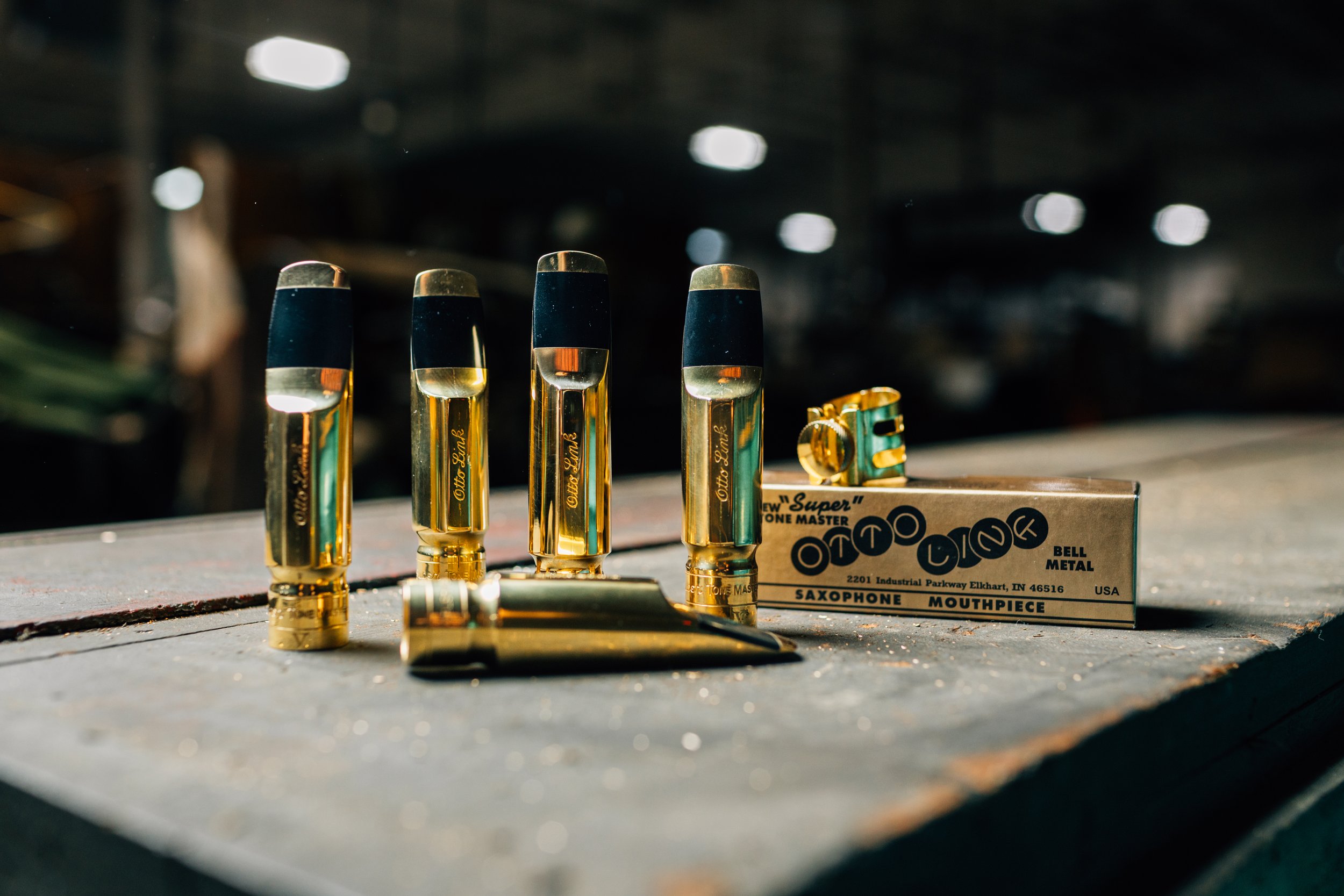
Historically, Otto Link metal mouthpieces were produced by forming two brass halves and joining them together. The faint line some players noticed on the chamber floor or body was simply the visible witness line from that joined construction. It was cosmetic, not structural, and did not indicate a flaw or failure in the mouthpiece.
That construction method was part of how metal mouthpieces were made for many decades, and countless iconic recordings were made on pieces built that way. The line itself was never a performance issue, but it was often misunderstood.
-
Why did JJ Babbitt change how Otto Link metal mouthpieces are constructed?
The change was driven by consistency, precision, and control.
In this new era, Otto Link metal mouthpieces are produced from a single piece of brass rather than two joined halves. This approach removes a variable from the process and allows tighter control over internal geometry and dimensional consistency.
Before making this change, JJ Babbitt conducted extensive R&D and validation, including work done in partnership with Theo Wanne Mouthpieces, to evaluate whether the construction method itself produced meaningful differences in sound or response.
While the metallurgical properties between the two approaches are subtly different, our findings were clear: those differences are not significant enough for players to perceive in real-world playing.
In short, this change improves consistency and precision without altering the voice players expect from an Otto Link metal mouthpiece.
-
Does the new metal construction method change the sound or feel of Otto Link metal mouthpieces?
No in any meaningful, player-detectable way.
The defining elements of how a mouthpiece sounds and responds are its internal geometry, facing, baffle, chamber, and overall design intent. Those elements remain intact.
The move to single-piece brass construction strengthens consistency and removes cosmetic confusion, but it does not remove character or change the fundamental playing experience. The goal was never to “modernize the sound,” only to modernize the process behind it.
If you’ve played and loved Otto Link metal mouthpieces in the past, the sound you expect is the sound we’re protecting.
Sound, Models, and Direction
-
Many modern players prefer brighter, louder mouthpieces. Does JJ Babbitt offer options for them?
Yes, and we approach that range intentionally.
Meyer and Otto Link have always been defined by balance, core, and musicality. That foundation hasn’t changed. At the same time, modern playing environments and styles often call for greater projection, clarity, and flexibility across genres.
Today, we offer models that lean more in that direction, such as the Meyer Bros Connoisseur Series, the Otto Link LA, and the Otto Link Florida. These mouthpieces provide increased projection and focus while still retaining the character Meyer and Otto Link are known for.
Looking ahead, our partnership with Theo Wanne Mouthpieces gives us the tools and process control to thoughtfully expand the tonal range we offer over time. The goal isn’t to chase brightness or volume for their own sake. It’s to give players reliable options across the full spectrum of sound, from classic warmth to modern clarity, without sacrificing identity.
The core remains. The range is expanding.
-
What role does baffle design play in the sound and feel of a mouthpiece?
The baffle is one of the most influential elements in how a mouthpiece responds and projects.
Its shape, height, and transition into the chamber directly affect airflow, resistance, brightness, and immediacy. In general, higher or more pronounced baffles increase projection and clarity, while lower or more gradual baffles emphasize warmth, depth, and blend. Neither approach is inherently better. They’re tools for different musical contexts and player preferences.
What’s often overlooked is that the baffle doesn’t work in isolation. Chamber shape, facing curve, tip opening, and the player’s own embouchure and oral cavity all interact with the baffle to create the final result. Small design differences can feel dramatic, which is why precision and repeatability matter.
In this new era, baffle designs across Meyer and Otto Link are executed with far greater control and consistency, ensuring that each mouthpiece reflects the intent of its design accurately and predictably.
-
Does improved consistency mean mouthpieces are less expressive or more “sterile”?
No. It means fewer unintended variables.
Expression comes from the player. Consistency ensures the mouthpiece doesn’t get in the way.
In the past, variability sometimes forced players to adapt to the mouthpiece rather than explore what the mouthpiece could offer. Improved consistency removes that friction. When geometry, facing, and response are more predictable, players can spend less time compensating and more time making music.
Two players can still sound completely different on the same model. Personal voice, embouchure, air concept, and musical intent remain the dominant factors. What consistency does is ensure that the mouthpiece delivers the design it claims to be, reliably.
In other words, consistency doesn’t flatten expression. It clears the path for it.
-
Will existing Meyer and Otto Link models change, or will only new models be added?
The core models that players know and trust are not being abandoned.
Our focus is first on executing existing designs more consistently and accurately than ever before. That means preserving the sound and feel players expect while improving reliability from piece to piece.
Over time, new models and variations may be introduced (or reintroduced ;) ) to address evolving player needs and musical contexts. When that happens, it will be intentional, clearly defined, and grounded in real-world testing and feedback.
Evolution will be additive, not disruptive.
Value, Access, and Philosophy
-
Why are JJ Babbitt mouthpieces priced lower than many competitors?
We’ve always believed that great sound should be accessible to more musicians, not fewer.
Meyer and Otto Link were never meant to be luxury collectibles. They were designed to be working mouthpieces trusted by students, professionals, and everyone in between. That philosophy hasn’t changed.
In this new era, with modern manufacturing precision, tighter tolerances, and improved consistency made possible through our partnership with Theo Wanne Mouthpieces, we could justify positioning these mouthpieces at a much higher price point. Many brands do exactly that, often charging a premium for automation, boutique positioning, or scarcity.
We’ve chosen a different path.
Efficiency and modern tooling exist to improve consistency and reliability, not to inflate margins. When the process improves, players should benefit. That’s why Meyer and Otto Link remain some of the strongest values in the market: iconic designs, modern standards, and pricing that respects the musicians who actually play them.
-
How does player feedback influence what JJ Babbitt does next?
Directly.
Player feedback isn’t treated as an afterthought or a marketing exercise. It’s a meaningful input into how designs are evaluated, refined, and evolved. Listening to players helps us validate assumptions, identify real-world needs, and avoid changes that don’t serve the music.
As consistency improves and process discipline increases, feedback becomes even more valuable. When variables are controlled, what players experience and report becomes clearer and more actionable.
If you care enough to share your experience, we care enough to listen. That dialogue is part of how this next chapter is being shaped.